
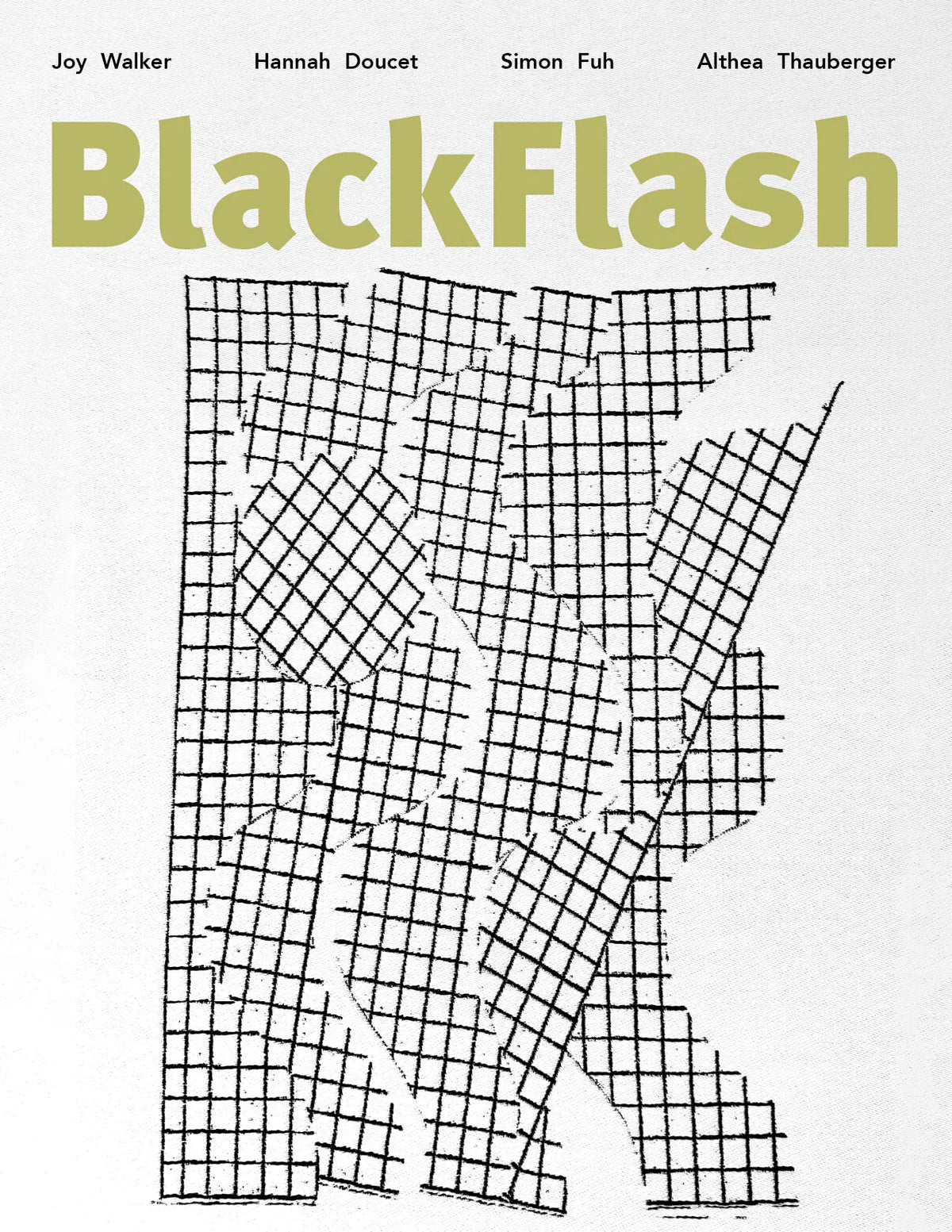
BlackFlash
BlackFlash 43.2
BlackFlash 43.2
Editorial Note:
Protean Maxxing
This issue is about homecoming and impermanence; it’s also about the relationship between the part and the whole and, as ever, the centre and the periphery. There is a newfound premium on moving against the logic of optimization. There are mementos and memento mori. There is the vertigo of coming back to a once-familiar place and finding it estranged. There is a folk-art mask that purges wheat. There is cannibalism. There are puppets.
In conversation with artist Joy Walker, writer Liza Eurich coins the phrase “grids misbehaving,” an apt and economical description of Walker’s practice, which deconstructs garments to reveal their underlying structures and forges new forms that are at once elegant and slightly absurd.
Taking things apart to discover what else they might become is a reoccurring impulse in this issue. Kahani Ploessl’s hybrid artist project BRUSH.jpg presents a custom-built interface that uses images sourced from the internet as a brush for digital drawing. Developed with an open-source ethos, the spread pairs a selection of drawings with online access to the tool itself, inviting readers to experiment firsthand.
Elsewhere, the issue takes an elemental turn. Writer Katie Lawson speaks with Manif d’art 12 curator Didier Morelli about the recent edition of The Quebec Biennale and its forthcoming publication, discussing how the theme of “Splitting Ice / Briser la glace” unfolds across disparate venues and artistic practices with an eye to site specificity and “nordicity.” In her profile of painter Chantal Khoury, writer Maegan Beck looks to water as a lens for reading the artist’s dreamlike, gauzy paintings, which populate her latest exhibition “Monuments” at Bradley Ertaskiran.
Inspired by his recent move back to the prairies, Simon Fuh’s series of drawings Cowboy Poet depicts surreal scenes of expressionless figures joyriding and hanging out. The accompanying text by Alana Traficante finds tenderness in these sometimes disturbing scenes, a “shared absurdity [that] holds people together in the space of unfolding fictions.” In a similar spirit of return, my profile of artist Althea Thauberger follows the often-itinerant artist back to her birthplace of Saskatchewan in her Remai Modern exhibition “Der Kleieklotzer (The Bran Puker).” There, she takes her own family history as a point of departure to explore how wheat farming has been instrumental to the colonial project of Canada.
Artist Hannah Doucet speaks with writer Shalaka Jadhav about the memento mori embedded in the still life tradition and her exhibition “Show me where it hurts” in the Buhler Gallery at St. Boniface Hospital, which brings her practice to the terrain of pediatric healthcare while recalling her own childhood experience as a cancer patient. Finally, artist Eleanor King receives a memento from the estate of Kelly Mark. Her subsequent essay reflects on Mark’s practice and relationship to the East Coast art scene. After hosting a reboot of Glow House in her own home, King muses, “Was it her piece? Not exactly. It was a memorial gesture, improvised and emotionally accurate, though I don’t know whether Kelly would have liked it. Probably not.”
Couldn't load pickup availability
Share
SHIPPING
SHIPPING
Orders over $125 (before taxes and after any discounts or promotions) ship FREE. We offer $20 flat rate shipping for all other orders.
At this time, The Gallery Store only ships to locations within Canada. All orders are shipped using Canada Post.
In-store pickup is available for all orders. We will contact you when your order is ready.
RETURNS
RETURNS
If you received a defective item, please contact us within 14 days of receiving the item to initiate the exchange process.
If you are dissatisfied with an item for any other reason, you may return it within 14 days of purchase for a full refund, minus the original shipping charges. Please note that you will be responsible for return shipping costs. Unfortunately, we cannot be held responsible for any packages that are lost or damaged in transit. To qualify for a full or partial refund (minus shipping charges), the item must be unused, unopened, and in its original, re-sellable condition, with all packaging materials included. Additionally, the original sales receipt must be provided with your return.
Please note that deodorant, soap, beauty products, jewellery, masks, and sale items are final sale.
ADD A DONATION